
Inner line permit is an official travel document that allows an Indian citizen to travel to restricted/protected borders areas of India. Prior to August 2021, such areas extended from Ladakh Union Territory to Arunachal Pradesh all along the India-China border.
Ladakh UT administration waved goodbye to the ILP condition for domestic tourist in August 2021.
Among northeastern states of India, Arunachal Pradesh, Mizoram, Nagaland, and Manipur state comes under the purview of ILP system.
Before 11 December 2019, ILP was only applicable to frontier states of Arunachal Pradesh, Mizoram, and Nagaland. A presidential order was signed on the day extending the purview of ILP to Manipur.
Apart from these Himalayan regions for India, ILP is also mandatory for Indian tourist planning to visit Lakshadweep (an archipelago off the coast of Kerala in the Arabian Sea).
ILP is only relevant to domestic Indian travellers. If a foreign national wish to visit the region that falls beyond the inner line, he/she has to apply for the inward travel permit under Protected Area Permit (PAP).
So, if you’re a foreign national looking to explore these stunning regions, PAP is your pass.
Under the Foreigners (Protected Areas) Order 1958, a protected area is defined as the area between the inner line and the international border.
The following regions of Kinnaur & Spiti valley falls under the protected area:
| Villages of Pooh block of Kinnaur | Spiti valley |
| Sumra, Shalkhar, Chango, Nako, Maling, Maling Dogri, Yangthang, Kaa, Leo, Hango, Chuling, Hangmat, Namgia, Khab, Tashigang, Dubling, Dabling, Pooh, Shayaso, Sunnam, Giabong, Taling, Ropa & Rushkulang, Nesang, Kanam, Labrang, Spillow, Moorang, Gramang, Thobaring, Khopka, Shilling, Ruwang, Thangi, Lumber, Charang, Kunnu, Lippa and Asarang. | Dhankar, Shichling, Tabo, Hurling, Lari, Gue, Sumdo, Korik |
Under the section 3 of the Foreigners (Protected Areas) Order 1958:
“No foreigner shall enter into or remain in any protected area except under and in accordance with a permit issued by the Central Government or any Officer authorized by the Central Government in this behalf.”
— Section 3 of the Foreigners (Protected Areas) Order 1958.
ILP/PAP for Northeastern States Vs ILP for Kinnaur and Spiti valley
| Kinnaur & Spiti valley | Northeastern states |
| Not required for Indian citizens | ILP is mandatory for Indian citizens. |
| Foreign nationals* can apply for ILP/PAP and visit the region. It is granted as a matter of routine. | Foreign nationals can apply for PAP, but it is issued only in extraordinary circumstances. |
| Application through offline process only | Application through online and offline process. |
An ILP/PAP holder can only visit the designation places (mentioned in the permit) for the period one is authorized to.
The permit is granted for a group of two or more people only, and you can’t stay in the protected/restricted region after the permit gets expired.
How to get ILP for Kinnaur & Spiti valley?
One can apply for Inner line permit either at
- District Collector/Magistrate (DC) office, Shimla
- DC/SDM office, Reckong Peo.
- DC office Kullu
- SDM office, Keylong.
- SDM office, Bhaba Nagar (Kinnaur)
- ADC/SDM office, Reckong Peo
- SDM office, Pooh (Kinnaur).
- ADC office Lahaul & Spiti at Kaza.
Essential documents you need to submit for permit application
- A copy of your valid Visa
- A copy of your valid Passport
- A completely filled-out application form
Note: Passport size photos are not required for the ILP application. Though, we recommend you to carry them with you.
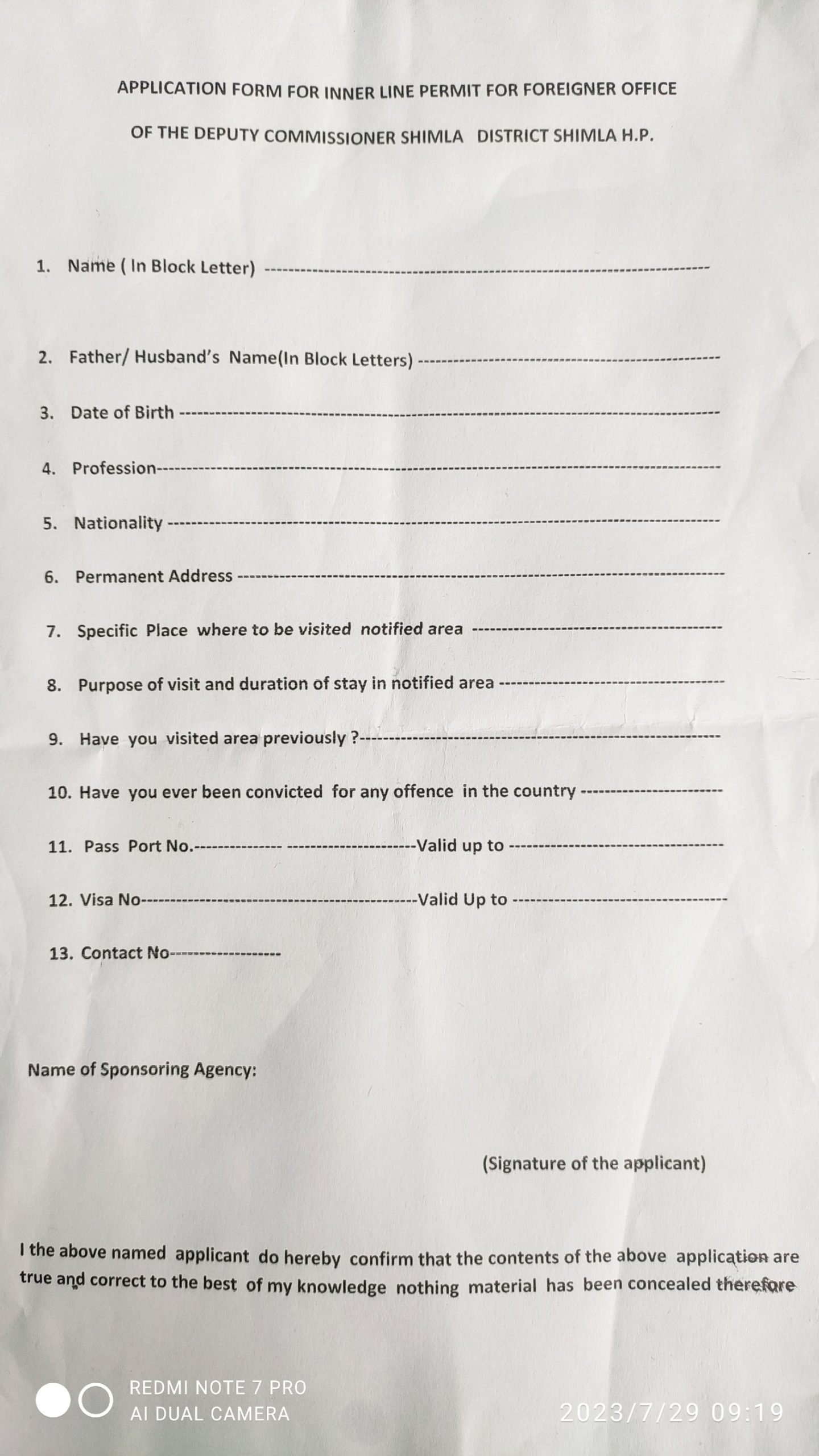
Apart from these documents, you can’t apply for ILP if you don’t have/know the following details:
- Travel itinerary
- A list of protected places you’re planning to visit.
- A sponsorship letter from registered tour operator/travel agency.
- Purpose of your visit and duration of travel in the restricted area
From Chandigarh there are routes to reach Spiti valley. One is via Manali-Atal Tunnel and second is via Shimla-Kinnaur-Sumdu. If you are taking the Manali route, you don’t need a travel permit until Kaza. You can visit Kaza and return to Manali without a permit.
But if you’re yearning to explore further into Kinnaur, that’s when you’ll want to secure your ILP at the ADC office in Kaza.
If you’re taking the Shimla-Kinnaur route, there are two places where you can apply for travel permit.
- DC/ADC office Shimla
- SDM Kalpa office (located within DC Office premises Reckong Peo, Kinnaur)
Where to get Inner Line Permit?
Reckong Peo and Pooh permit offices are the recommended places to get the permit. At these places, applicants are few, and permit processing time is relatively less than the other permit offices. So, if time is running a bit short, and you’re not keen on getting caught up in the permit paperwork, these offices should be your go-to choices.
Step-by-Step Process
Whether you’re applying for ILP travel permit at ADC office Shimla, ADC office Kaza or at SDM Office Reckong Peo, the application process remains, more or less, the same.
Here is the step-by-step process:
- Carry your valid passport, visa, and travel itinerary. Make photocopies of each before arriving.
- If you are applying through a registered travel agent, the agent will collect the required documents and fill out the application on your behalf.
- Submit your application to the designated officer at the respective office.
- You will be required to present yourself in front of a webcam for a photograph — at the Sugam Centre if applying in Shimla, or at the RLA Office if applying in Reckong Peo.
- Your application will be reviewed by ADC/SDM.
- Your application will be reviewed by the ADC or SDM, who may ask routine questions regarding the nature and itinerary of your visit.
- Permit processing typically takes between 30 and 60 minutes under normal circumstances.
Note: If you are a citizen of Pakistan, Afghanistan or China, application for ILP for Kinnaur Spiti valley wouldn’t be approved by any of the designated offices. If this case, your application can only be approved by Ministry of Home Affairs (MHA), New Delhi.
If you have any questions/doubts about Kinnaur-Spiti ILP application/processing, you can contact the concerned authorities at Shimla and Reckong Peo.
| SDM/DTDO Kinnaur | sdmklp-kin-hp@nic.in | +911786-222253 |
| DC/ADC office Shimla | tourismmin-hp@nic.in | +91177-2625511 |
Travel permit (ILP/PAP) fee
The official fee for an Inner Line Permit is ₹250. However, the amount you actually pay will depend on where and how you apply. At Shimla Sugam Center, the fee is ₹400 and some charges may be levied by the centre’s staff for facilitating the process.
The Sugam Center guys at Shimla and local travel agents at Reckong Peo may charge an additional service fee in lieu of faster travel permit processing and helping you sail through the process smoothly.
At Reckong Peo, the permit fee ranges between ₹600 and ₹800. The local travel agents charges some additional fee in exchange for expedited processing and end-to-end assistance with the application.
Guidelines for travel agents
Ministry of Home Affairs issued the following guidelines/instructions for travel agents under Chapter 17 of Visa Manual for Restricted and Protected areas Special Permit applicants on 17 March 2011:
- Travel agents and tour operators are responsible for ensuring that every tourist group they sponsor holds a valid Restricted/Protected Area Permit before travel.
- It is the duty of the travel agent/tour operator to ensure that tourist groups travel only to permitted locations and they do not overstay beyond the validity of the travel permits issued to them,
- Owners of homestays, guesthouses, and hotels must allow only foreigners with valid Restricted/Protected Area Permits to stay and notify the local police of the arrival or departure of any foreigner within 24 hours.
- Anyone failing to follow the above instructions will face legal action under the Foreigners Act, 1946.
Apply for permit
Office hours of permit offices
All the permit offices in Himachal Pradesh remain open from 10AM to 5PM, except on the public holidays listed by the government of India and state government of Himachal.
Minimum pax clause
At Shimla permit office, a group of at least 2 foreign nationals is mandatory. Though, at Reckong Peo, Pooh and Kaza office, a solo traveller can apply for the permit.
Check Posts
After you get the permit from Shimla/Reckong Peo permit office, your ILP and passport will be checked at Dubling and Sumdo check post (the border of Kinnaur and Spiti valley). You need to submit a copy of your permit at these check posts/barrier stations run by Himachal Police/Indian Army.
Earlier there used to be a Jangi Check Post (near Akpa bridge) where domestic tourist had to show their IDs and international travellers had to submit a copy of their travel permit. Now, this post has been shifted to Dubling.
Validity
An ILP is valid for 15 days. If you plan to stay/travel for an extended period in the restricted area, you will need to renew your permit.
Climbing permit for mountaineers
Under the Chapter – II (Restrictions On Certain Activities Of Foreigners) of Immigration and Foreigners Order 2025, foreign nationals are prohibited from undertaking mountaineering expeditions in India without obtaining prior approval from the Union Government. All applications for mountaineering expedition permits must be submitted to the Indian Mountaineering Foundation (IMF), New Delhi.
The Government of India has notified, under the First Schedule of the Immigration and Foreigners Order, 2025, a list of mountain peaks that foreign nationals may climb without seeking direct permission from the Union Government. For peaks listed under the First Schedule, IMF approval alone is sufficient.
The citizens of China, Pakistan, Bangladesh, and Afghanistan are required to obtain prior permission from the Government of India even for peaks listed under the First Schedule.
Applications for mountaineering expedition permits should be submitted to the IMF at least 90 days before the planned expedition start date. We strongly recommend applying at least four months in advance to allow adequate processing time.
Applications may be submitted by post or email to:
The Honorary Secretary, Indian Mountaineering Foundation,
6, Benito Juarez Marg, South Campus, South Moti Bagh, New Delhi -110021.Email: director@indmount.org
Liaison Officer for mountaineering expeditions
Every foreign mountaineering expedition operating in India — regardless of whether the peak falls within a Protected or Restricted Area — is required to be accompanied by a Liaison Officer (LO) appointed by the Government of India through the IMF.
The Liaison Officer serves the following functions:
- Monitors the expedition’s compliance with applicable mountaineering rules and regulations.
- Coordinates with local civil authorities and the military, particularly in sensitive border regions.
- Submits a formal expedition report upon conclusion of the climb.
Climbing permit fee
Foreign climbers must pay peak climbing fees, which vary by altitude.
Typical IMF peak climbing fees are:
- Below 6500 m summit altitude: about USD 500 for two climbers
- 6501–7000 m summit altitude: about USD 700 for two climbers
- 7001 m and above summits: about USD 1000 for two climbers
History and Evolution of Inner Line Permit
The roots of ILP lie in occupation of Assam (in 1822) by Burma and subsequently by the British East India company and expansion of its trade in this region. With the signing of peace treaty of Yandabo in 1826, Assam and Manipur became frontier territories of British India empire.
East India Company acquired large tracts of land for tea plantation and oil exploration in the Assam plains. This caused conflict with the hill tribal population, who depended on hunting and gathering for their livelihood. The tribesman began raiding the tea estates and trading posts of the company.
To prevent this, the British government formulated the so-called “Regulation for Peace and Good Government” which later became Inner Line Regulation/Bengal Eastern Frontier Regulation (BEFR) Act of 1873.
The British government claimed that that idea behind enacting this act was to protect cultural identities and traditional ethos of the local tribal population. In reality, it was enacted to protect the commercial interest of the British government.
Under the BEFR Act, regulations were framed to restrict the entry and contain the stay of “British subjects” (citizens of British India empire) and foreign nationals.
After India’s independence (in 1950), the clause “British subjects” was replaced with “Citizens of India” and the rest of the act remained the same. The government of free India opted to let the act in force due to the following reasons:
- To protect the native culture and indigenous tradition and customs of the frontier region.
- To restrict the entry of illegal immigrants.
- To safeguard the tribal demography of the population.
On April 4 2025, the government of India enacted Immigration and Foreigners Act 2025. This act superseded/replaced the Foreigners Order 1948, the Foreigners (Protected Areas) Order 1958, the Foreigners (Restricted Areas) Order 1963 and the Foreigners (Tribunals) Order 1964.
Subsequently, on September 1 2025, the union government of India notified Immigration and Foreigners Order 2025 under the act ibid.
This order introduced significant changes to the process of applying for Protected Area Permits (PAP) and Restricted Area Permits (RAP).
The key provisions of the order are:
- Every foreign national intending to visit a Protected or Restricted Area is required to obtain a permit prior to entering or traveling into the said area (Chapter IV, Para 14).
- Bhutanese citizens are generally exempt from the permit requirement when travelling through Protected or Restricted Areas. However, this exemption does not apply to Bhutanese nationals of Afghan, Chinese, or Pakistani origin — defined as any individual, or either of whose parents or grandparents, was born in and was permanently resident in Afghanistan, China, or Pakistan. Such individuals must obtain the requisite permit before visiting any Protected or Restricted Area.
- Citizens of Afghanistan, China, and Pakistan are not eligible to be issued a Protected Area Permit or Restricted Area Permit through any designated local authority. Applications from nationals of these countries can only be considered/approved by the MHA, the government of India.
- Every foreigner intending to visit or stay in any Protected area or Restricted area must submit an application for a travel permit through e-FRRO portal or the mobile application Indian Visa Su-Swagatam.
- The Protected Area Permit or Restricted Area Permit shall be issued electronically.

- Insights from SPAI Snow Leopard Population Study in Himachal Pradesh – October 21, 2025
- Himachal Pradesh Home Stay Rules 2025 – June 26, 2025
- HRTC Baggage Policy & Terms Decoded (Tips & Fee Chart) – April 21, 2024


Leave a Reply